

The best SEO tool is the one that removes the next constraint in your workflow. Sitetrail’s Free SEO Course + Certification is our first recommendation because informed decisions come before tool selection. ChatGPT follows at number two for research, synthesis and execution support; NewsPass from Sitetrail is third for SEO, PR and generative engine optimization; and Semrush is fourth as the highest-ranked conventional all-in-one SEO platform here. Google Search Console remains essential because it reports what Google actually sees and how your own pages perform.
No single platform handles every part of search engine optimization equally well. Keyword discovery, technical auditing, content optimization, digital PR, backlink analysis, page-speed testing and performance measurement require different data and different actions. The right answer is usually a compact stack of complementary tools, not an expensive collection of overlapping subscriptions.
This guide evaluates software, first-party data sources, workflow resources and specialist services together because SEO results depend on all four. It is intended for site owners, in-house teams, consultants and agencies deciding what to use, what to combine and what they can safely skip. If you need execution support as well as software, start with our broader SEO services guide.
Top 21 SEO tools: the ranking at a glance
The course now leads this editorial ranking, with the existing tools retained below it. “Best for” identifies the job each entry performs most convincingly; it does not imply that every item is a like-for-like software substitute.
| Rank | Tool or resource | Best for | Type |
|---|---|---|---|
| 1 | Free SEO Course + Certification | Current SEO judgment, practical skills and a shareable assessment | Free learning and assessment resource |
| 2 | ChatGPT | Research, synthesis and workflow support | AI assistant |
| 3 | NewsPass from Sitetrail | Search visibility, media presence and AI discoverability | SEO, PR and GEO resource |
| 4 | Semrush | All-in-one competitive SEO | Software suite |
| 5 | HARO-Style Brand Mentions | Expert commentary and earned mentions | Digital PR method |
| 6 | Yoast SEO | WordPress on-page controls | WordPress plugin |
| 7 | Google Search Console | Google performance and index diagnostics | First-party data |
| 8 | Referral Traffic Builder | Diversified discovery and referral visits | Traffic service |
| 9 | PageSpeed Insights | Core Web Vitals and performance diagnosis | Testing tool |
| 10 | Moz Pro | Accessible campaign monitoring | Software suite |
| 11 | Google Ads Keyword Planner | Commercial keyword discovery and forecasts | Advertising data tool |
| 12 | SEO SpyGlass | Desktop backlink auditing | Desktop software |
| 13 | SearchAtlas | Agency execution and automation | Software suite |
| 14 | Ahrefs | Backlinks, competitors and AI visibility | Software suite |
| 15 | Surfer SEO | Search-informed content optimization | Content platform |
| 16 | Google Trends | Seasonality and demand direction | First-party trend data |
| 17 | Sitetrail Turbo | WordPress publishing workflow | WordPress plugin |
| 18 | LinkAssistant / SEO PowerSuite | Desktop SEO operations | Desktop suite |
| 19 | AnswerThePublic | Question and topic ideation | Search-listening tool |
| 20 | Definite SEO Analyzer | Fast page-level checks | SEO checker |
| 21 | Google SEO Training | Learning fundamentals | Training resource |
How we evaluated these SEO tools
This is an editorial ranking, not a laboratory benchmark. We assessed each entry by the quality of the problem it solves, the usefulness of its output, the amount of manual work it removes, its fit with other tools and its relevance to search in 2026. We also considered whether a small business can act on the information without needing a full data team.
- Data quality: Is the information first-party, independently crawled, estimated or generated?
- Actionability: Does the output lead to a clear technical, editorial or promotional decision?
- Coverage: Can the tool solve several related jobs without obscuring the details?
- Workflow fit: Does it export, integrate or cooperate with the rest of a modern SEO stack?
- Value: Is the time or capability gained proportionate to the cost and learning curve?
- Search evolution: Does it help with classic search results, AI answers, brand visibility or all three?
Pricing and feature limits change frequently, so this guide avoids brittle package quotes. Confirm current allowances with the provider before purchasing. Where a score or forecast is proprietary, compare the direction over time rather than treating the number as an objective fact.
The 21 best SEO tools and resources reviewed

1. Free SEO Course + Certification
Best for: beginners, existing SEO practitioners, aspiring SEO directors and business owners who want to make better search marketing decisions.
The most useful upgrade to your SEO stack can be the knowledge you use to operate it. Sitetrail’s free SEO course with certification comes first because more software cannot repair an outdated strategy. A dashboard can identify a pattern; you still need to know whether it matters, what to investigate and which action is justified.
Why updating your SEO knowledge is essential
Search interfaces, ranking systems and customer journeys change. Rules of thumb inherited from old courses can become wasteful or risky when treated as universal instructions. Review the habit, the evidence behind it and the business outcome it is meant to improve before repeating it at scale.
- Replace rigid link formulas with editorial judgment. Demanding keyword-rich anchors in every placement, chasing fixed anchor percentages or adding repetitive self-serving links is not a dependable strategy. Google identifies manipulative link practices and optimized anchors in distributed advertorials as link-spam risks. Descriptive anchor text is still useful; the lesson is to distinguish helpful context from manipulation and respect editorial choices.
- Replace volume targets with useful evidence. More pages, more links and higher third-party authority scores do not by themselves demonstrate customer value. Learn to prioritize original insight, technical access, audience relevance and factual trust.
- Account for zero-click and AI discovery. Understand brand mentions, citations, clicks and enquiries as different observations. An unlinked mention can contribute to recognition, but it is not automatically a backlink or proof of a ranking gain. Google’s AI search features build on existing SEO fundamentals; there is no special markup that guarantees inclusion.
- Turn reports into decisions. Use first-party evidence, clear baselines and practical checks to decide what to change, then verify the result instead of treating every tool recommendation as an instruction.
The course includes 93 lessons across 18 modules, covering SEO, Search Engine Marketing (SEM) and Generative Engine Optimization (GEO). Each lesson combines a visual explanation, worked examples, a “Do this today” practical task and a multiple-choice knowledge check. Topics extend from E-E-A-T and algorithm history to local SEO, ecommerce, migrations, measurement and the convergence of PR and SEO.
Take the free 80-question skills assessment, receive a rating across eight disciplines and download your Sitetrail certificate image to share on LinkedIn. The assessment is self-administered, and no Sitetrail account is required.
Start the Free SEO Course + Certification →
Supporting references: Google’s link-spam policies and Google’s guidance on AI features and websites.
Verdict: start here to update your judgment, identify gaps and use the tools below more effectively. This is Sitetrail’s own free educational resource, included in our editorial ranking.
2. ChatGPT
Best for: research assistance, synthesis, briefs, structured analysis and repeatable SEO workflows.
ChatGPT follows the course at number two because it can support almost every stage of an SEO project when it is given reliable inputs and a precise task. Use it to cluster exported keywords, compare the intent behind competing pages, transform crawl findings into tickets, build content briefs, classify Search Console queries, draft regex patterns, summarize research and create quality-control checklists. Search can retrieve timely information with source links, while deeper research modes are suited to multi-step questions that need a documented synthesis.
Its greatest value is not one-click article generation. It is the ability to reason across your own evidence: a crawl export, customer interviews, analytics notes, product documentation and competitor observations. Give it the source material, define the audience and conversion goal, require uncertainty to be marked, and ask for a table showing which claim came from which input.
Limitations: generated answers can be incomplete, outdated or wrong. Search-volume figures, ranking claims, quotations, legal statements and product specifications need verification. Unedited generic copy also tends to erase first-hand experience—the part of a page competitors cannot easily reproduce.
Verdict: the most flexible tool in this ranking, provided an accountable human remains responsible for evidence, originality and publication.
3. NewsPass from Sitetrail
Best for: agencies and brands building search visibility, media presence, brand credibility and discoverability in AI answers.
NewsPass brings SEO, PR and generative engine optimization together around search visibility, media presence and brand credibility. It ranks third as a resource for putting a campaign into practice: teams select relevant publications available on their plan, prepare useful content and submit it for editorial review. Those are delivery steps toward the customer’s marketing goals.
Start the campaign with audience relevance. Choose publications whose real readership overlaps your market, develop an original angle, disclose commercial relationships where required and use varied, natural citations. A large placement count is not a substitute for editorial value. One credible feature that is useful to the publisher’s audience can be more defensible than many low-context placements.
For teams that want the wider agency workflow rather than a single tactic, the Sitetrail MSCP provides the related service context. Measure success through qualified referral visits, assisted conversions, brand search, relevant mentions and the quality of referring pages—not a third-party authority score alone.
Verdict: a useful resource for teams pursuing coordinated SEO, PR and GEO outcomes, with editorial judgment and audience relevance guiding execution.
4. Semrush
Best for: an integrated view of competitors, keywords, rankings, site health and AI visibility.
Semrush is the highest-ranked conventional SEO suite on this list. Its core appeal is breadth: keyword research, competitive visibility, position tracking, backlink analysis and technical site auditing can live in one campaign environment. That makes it especially useful when several people need a shared picture of priorities rather than separate exports from unrelated tools.
Our detailed Semrush review explains the platform in more depth. A productive starting sequence is to benchmark direct search competitors, audit the site, group issues by likely impact, find keyword gaps and track a tightly selected set of commercial and informational queries. Teams can also evaluate the platform through this option to try Semrush.
Current AI-visibility capabilities extend the workflow into mentions, citations, share of voice and prompt tracking across major answer engines. These signals are valuable for comparison, but they should be reported separately from organic clicks and revenue. A brand mention, a cited page and a website visit are three different outcomes.
Limitations: feature breadth can overwhelm new users, estimates will not exactly match first-party analytics, and plan limits matter. Decide which reports change a decision before paying for more data. For narrower options, compare the specialist keyword research tools in our separate guide.
Verdict: the best all-in-one choice here for agencies and established teams that will actively use its connected datasets.
5. HARO-Style Brand Mentions
Best for: turning genuine expertise into editorial mentions and relationships.
Journalist-request and expert-source workflows connect writers who need credible commentary with specialists who can answer quickly. The method works when the response is specific, quotable and supported by experience or evidence. It fails when outreach is automated, self-promotional or unrelated to the request.
Create a simple response system: nominate experts by topic, monitor relevant requests, answer the question in the first sentence, add one defensible insight and include concise credentials. Never invent experience. Do not demand a followed link, and do not treat every response as a transaction. The long-term asset is trusted source status with writers who may return for future stories.
Our HARO link-building guide covers the approach, alternatives and practical expectations. Track accepted contributions, live mentions, referral traffic, relationship quality and the topical relevance of coverage.
Verdict: one of the best low-software methods for earning credible visibility, but speed, expertise and relevance determine the result.
6. Yoast SEO for WordPress
Best for: managing common on-page and technical SEO controls inside WordPress.
Yoast makes recurring page-level tasks easier for WordPress editors. Depending on configuration and edition, it supports title and meta-description controls, canonical handling, XML sitemaps, schema output, readability feedback and social previews. This reduces the chance that basic metadata and indexation settings are missed during publishing.
Install Yoast SEO as a publishing control layer, not as a ranking switch. Its colored checks are editorial prompts. A green score cannot prove that a page satisfies intent, contains original evidence or deserves links, while an excellent specialist article may reasonably ignore a stylistic suggestion.
Limitations: conflicting SEO plugins, duplicated schema and careless indexation settings can create problems. Use one primary SEO plugin, understand the defaults and test important templates after changes.
Verdict: a dependable WordPress foundation that is most effective when paired with sound information architecture and editorial review.
7. Google Search Console
Best for: understanding Google Search performance, indexing and page-level eligibility.
Google Search Console is essential because it supplies first-party information about your property. Its performance reporting shows clicks, impressions, queries, pages, countries, devices and average position; index and inspection tools help diagnose whether Google can access and index important URLs. Third-party tools are excellent for market discovery, but Search Console is the reference point for what happened to your own pages in Google Search.
A useful weekly process is to separate branded and non-branded demand, compare periods, inspect pages losing clicks, find high-impression queries with weak click-through rates and identify URLs sitting close to stronger visibility. Connect the observation to a hypothesis before editing: demand may have changed, the result layout may be different, a competitor may have improved or the page may no longer satisfy intent.
Limitations: the interface is not a full competitive research suite, data is aggregated, and average position is not a fixed rank. Search Console also should not be confused with analytics: clicks from search and on-site sessions are measured differently.
Verdict: the non-negotiable measurement tool in every Google SEO stack.
8. Referral Traffic Builder
Best for: building discovery routes beyond a single search engine.
Referral traffic comes from relevant links, mentions, communities, partnerships and publisher coverage. A Referral Traffic Builder can complement organic search by helping audiences discover a brand elsewhere on the web. This matters because qualified referral visits can introduce buyers before they perform a branded search.
Judge this channel by relevance and behavior. Tag campaigns, review engaged sessions and assisted conversions, and compare placements by topic, audience and page context. Raw visit volume without intent can distort reporting. Referral activity should also remain compliant with publisher rules and search-engine policies; paid or sponsored relationships need appropriate disclosure and link attributes.
Verdict: useful for diversifying acquisition and supporting brand demand when placements are audience-led and transparently measured.
9. PageSpeed Insights
Best for: diagnosing user-experience performance with field and lab data.
PageSpeed Insights combines real-user field information, when sufficient data exists, with Lighthouse lab diagnostics. This distinction is critical. Field data describes how eligible Chrome users experienced a URL or origin over time; lab data runs a controlled test intended to expose reproducible opportunities.
Start with Core Web Vitals, then investigate the underlying causes: oversized media, slow server response, render-blocking resources, unstable layouts, excessive JavaScript and third-party scripts. Test representative templates rather than only the homepage. After deploying a fix, monitor field data and business metrics because a better lab score does not automatically mean more conversions.
Limitations: individual lab runs vary, field data may be unavailable on low-traffic URLs, and a perfect score can consume engineering time that would be better spent elsewhere. Prioritize material user problems.
Verdict: the best free starting point for performance diagnosis, especially when developers can translate recommendations into template-level fixes.
10. Moz (SEOmoz) — Moz Pro
Best for: approachable keyword, rank, crawl and link workflows.
Moz Pro packages common campaign tasks into a relatively accessible suite. Typical uses include keyword exploration, rank tracking, site crawling, on-page recommendations and link research. Its well-known proprietary metrics help teams compare pages and domains consistently inside the Moz ecosystem.
Use proprietary scores comparatively: examine why two sites differ, watch the trend and corroborate the conclusion with rankings, referring-domain quality and first-party traffic. A Domain Authority number is not used by Google and should never become a campaign objective by itself.
Limitations: agencies with very large datasets may prefer a different index or reporting workflow, and metric definitions differ across vendors. Standardize one measurement system before presenting changes to clients.
Verdict: a solid, teachable suite for small and mid-sized teams that want core SEO functions without constructing a highly customized stack.
11. Google Ads Keyword Planner
Best for: discovering commercially relevant terms and estimating paid-search demand.
Inside Google Ads, Keyword Planner can generate keyword ideas and forecasts using seed terms or a website. Although it is built for advertising, SEO teams use it to understand commercial vocabulary, relative demand and the phrases advertisers consider valuable.
Do not convert advertising metrics directly into organic forecasts. Competition describes the advertising auction, not organic ranking difficulty, and search-volume ranges can be broad. Combine the output with live results, Search Console, Trends and customer language. The best content target is the intersection of demand, business relevance and an intent your page can genuinely satisfy.
Verdict: a useful bridge between paid and organic research, especially for teams that already operate Google Ads.
12. SEO SpyGlass
Best for: detailed desktop backlink reviews and link-profile comparisons.
SEO SpyGlass is the backlink-analysis component associated with SEO PowerSuite. It can organize linking domains, anchor text, link types and historical changes, compare competitors and estimate penalty risk. The desktop format appeals to practitioners who want local project files and highly configurable workspaces.
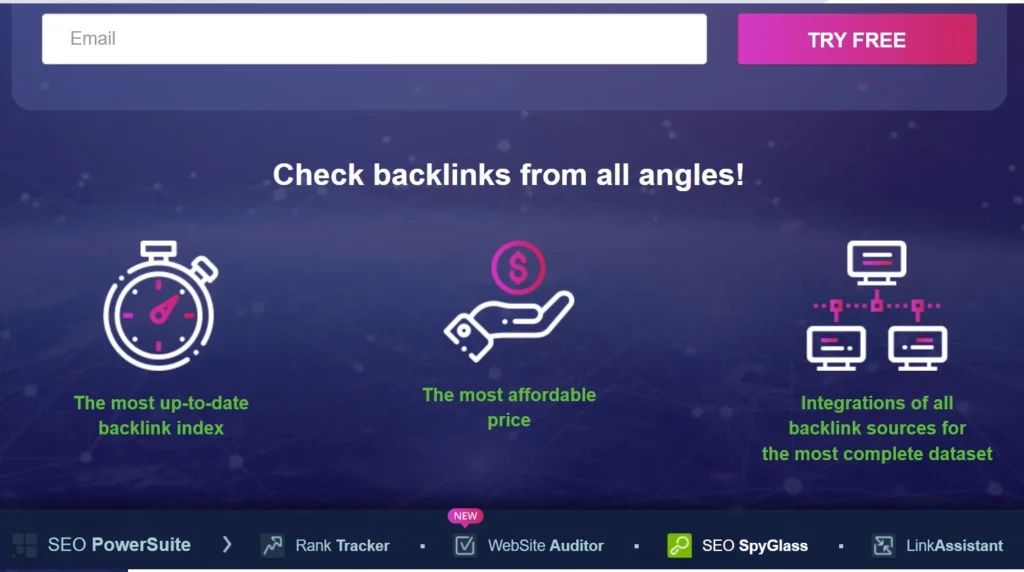
Risk labels require manual review. Google recommends disavowal only in limited circumstances involving substantial spammy or artificial links and a genuine risk of manual action. Do not upload a disavow file merely because a third-party score turned red. Investigate the linking page, pattern, history and context first.
Verdict: a capable option for practitioners who prefer a desktop research environment and understand the limits of automated link-risk scores.
13. SearchAtlas
Best for: agencies that want research, content, auditing and automation in one operating environment.
SearchAtlas positions itself as an integrated SEO platform with keyword and competitor research, content tooling, site auditing, link-related workflows and automation. Its appeal is operational: agencies can move from an identified opportunity to a managed task without stitching together as many separate products.
Automation should be deployed in stages. Start with one site section, define protected templates and pages, record the baseline, approve recommended changes and monitor the result. Never give a new automation unrestricted publishing authority before you understand its behavior on canonicals, internal links, metadata and existing content.
Verdict: a broad agency-oriented platform whose value depends on disciplined configuration, testing and human approval.
14. Ahrefs
Best for: backlink intelligence, competitive research, content discovery and AI-visibility monitoring.
Ahrefs is widely used for Site Explorer, Keywords Explorer, Site Audit, Rank Tracker and Content Explorer. Its strength is moving between a competitor’s organic footprint, the pages attracting links, keyword opportunities and the domains or pages responsible for authority. Our explanation of the Ahrefs backlink checker is a useful starting point.
The platform’s AI-visibility tooling also distinguishes mentions from citations and can compare share of voice across answer platforms. That distinction improves reporting: a brand may be named without its website being cited, or a page may be cited without producing a click. Use prompt-level findings to identify missing evidence, weak third-party corroboration and topics competitors own.
Limitations: traffic and keyword figures are estimates; credits, projects and feature access depend on the current plan. Export only the data required to answer a defined question.
Verdict: one of the strongest specialist research platforms for teams that make backlinks and competitor evidence central to strategy.
15. Surfer SEO
Best for: building and reviewing content against search-result patterns.
Surfer SEO analyzes pages that rank for a target query and converts observable patterns into content recommendations. It can help a writer identify recurring entities, subtopics, questions and structural gaps before or during drafting. Content audits can also surface existing pages that may need better coverage or alignment.
The productive use is diagnostic, not mechanical. Review which competing pages truly share the same intent, exclude outliers, then use recommendations as a coverage checklist. Add first-hand examples, data, expert interpretation and a clear point of view. Matching an average word count or repeating every suggested phrase does not create the best answer.
Limitations: correlation-based recommendations can reward imitation and over-optimization if followed blindly. The current results page is evidence about what ranks now, not a specification supplied by the search engine.
Verdict: valuable for disciplined content teams that want search-informed briefs while retaining strong editorial control.
16. Google Trends
Best for: comparing interest, spotting seasonality and validating the direction of demand.
Google Trends shows normalized search interest across time, locations and search surfaces. It is particularly useful when two phrases describe the same concept, demand changes seasonally or a new topic is rising too quickly for static keyword databases to represent well.
Choose deliberately between a search term and a topic. A term measures the entered wording; a topic can group a broader concept across variations and languages. Compare like with like, keep geography and time range consistent, and use related rising queries to inform—not dictate—the editorial calendar.
Limitations: values are relative, not absolute search counts. Low-volume terms may lack enough data, and a spike can represent news interest rather than buying intent.
Verdict: the best free companion for adding timing and demand context to conventional keyword research.
17. Sitetrail Turbo
Best for: speeding up WordPress publishing and content operations.
Sitetrail Turbo is designed around publishing workflow rather than third-party rank estimation. This category of tool becomes valuable when the strategic bottleneck is no longer ideas but the consistent creation, formatting, review and release of useful pages.
Set non-negotiable controls before scaling: unique page purpose, verified claims, correct authorship, intentional internal links, suitable images, editorial approval and a scheduled post-publication review. Faster output magnifies both good systems and weak ones.
Verdict: useful when WordPress production capacity is the constraint, provided quality assurance stays inside the workflow.
18. LinkAssistant / SEO PowerSuite
Best for: desktop-based rank tracking, site auditing, backlink research and outreach management.
SEO PowerSuite combines several desktop applications, including Rank Tracker, WebSite Auditor, SEO SpyGlass and LinkAssistant. Together they cover keyword monitoring, technical and on-page review, backlink analysis and prospect management. Users who want configurable local projects and scheduled reports may prefer this model to a browser-only subscription.
LinkAssistant can organize prospects and communications, but outreach quality still depends on targeting. Segment prospects by editorial relevance, explain why the proposed asset fits their audience and personalize only where there is a real reason. Bulk outreach with artificial familiarity damages the sender’s reputation.
Verdict: a broad desktop toolkit with meaningful depth, best suited to practitioners willing to configure and maintain its workflows.
19. AnswerThePublic
Best for: discovering questions, comparisons and modifiers around a topic.
AnswerThePublic turns autocomplete-style search ideas into grouped visualizations and lists. It is useful early in research because it exposes the language people may use when asking why, how, when, where or whether, as well as comparison and preposition patterns.
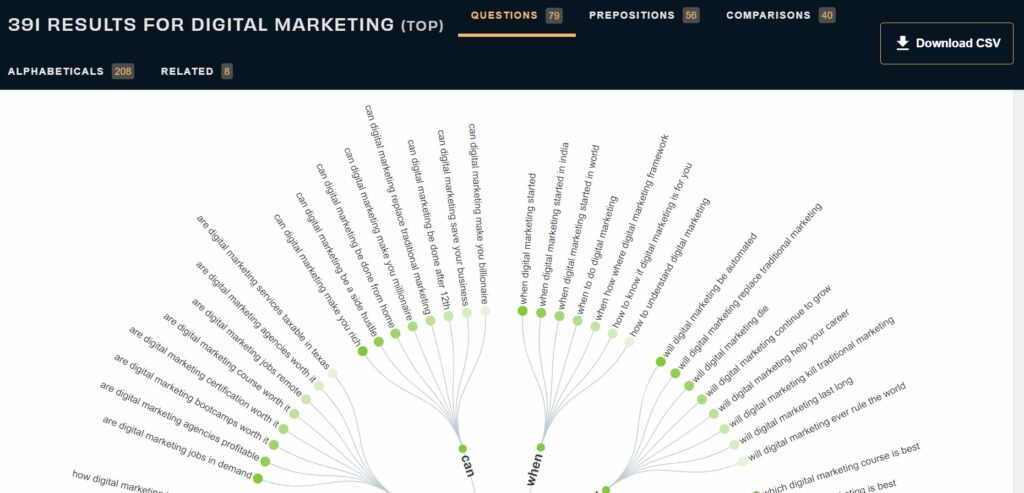
Export ideas, remove duplicates, group them by intent and check which questions require distinct answers. Several closely related questions usually belong in one authoritative page. Validate importance through customer conversations, results-page evidence and available demand data.
Verdict: an excellent ideation aid, particularly for FAQ research and long-tail coverage, but it needs a second tool for prioritization.
20. SEO Analyzer from Definite SEO
Best for: a fast initial review of visible page-level SEO signals.
The Definite SEO Analyzer offers a quick way to inspect common issues and create a starting checklist. Lightweight checkers are convenient for pre-publication reviews, sales conversations and identifying obvious omissions before a specialist performs a deeper crawl.
Automated checks only observe what their rules cover. They may flag a deliberately short title, miss a rendering problem, misunderstand page purpose or overstate a minor issue. Confirm significant findings in the source, rendered page, Search Console and browser developer tools.
Verdict: useful for rapid triage, but not a replacement for crawling, log analysis or an experienced technical review.
21. SEO Training — Learn with Google
Best for: understanding search and digital-marketing fundamentals before purchasing complex software.
Training belongs in the ranking because an untrained operator can misread even excellent data. Google’s learning resources explain core digital concepts and provide a foundation for understanding discovery, measurement and optimization. Availability and course names can vary by market, but this Google SEO training resource is the existing starting link from this guide.
Learning should alternate with practice. Verify a small property in Search Console, inspect its pages, write a hypothesis, make one defensible change and measure the outcome. This prevents certification knowledge from remaining abstract.
Verdict: foundational knowledge produces a better return from every paid tool that follows.
Bonus mentions
NeilPatel.com / Ubersuggest
Ubersuggest is a practical entry-level option for keyword ideas, competitor observations, content discovery and basic site analysis. It can suit owners who need a more guided interface before moving to a larger suite. As with every third-party platform, compare estimated traffic and difficulty directionally and verify your own results with first-party data.
Pay Per Click Calculator
Organic and paid search compete for the same budget and frequently illuminate each other. Use the Pay Per Click Calculator to model the relationship between spend, clicks, conversion rate and acquisition cost. A forecast is not a promise; run sensitivity scenarios and replace assumptions with real campaign data as soon as it becomes available.
Which SEO tool stack should you choose?
Choose one primary platform, first-party measurement and only the specialist tools that solve a proven gap. More subscriptions do not create a better strategy when every tool produces the same unused audit.
Small WordPress site
Search Console + PageSpeed Insights + Yoast + ChatGPT. Add Trends for seasonal topics and a specialist suite only when competitive research becomes a recurring need.
Content-led company
Search Console + Semrush or Ahrefs + ChatGPT + AnswerThePublic or Surfer. Retain original interviews, examples and editorial review as the differentiating layer.
SEO agency
Search Console per client + one broad suite + a crawler/workflow platform + controlled publishing and digital PR resources. Standardize definitions across every report.
Local or service business
Search Console + a straightforward suite such as Moz Pro + PageSpeed Insights + customer-language research. Focus on service clarity, proof, location relevance and lead quality.
How to interpret SEO data without being misled
SEO dashboards mix measured data and modeled data. Search Console clicks are first-party observations from Google Search; a third-party tool’s traffic figure is an estimate derived from its database and assumptions. Both are useful, but they answer different questions.
- Define the decision. “Which existing page should we refresh?” is better than “What does the dashboard say?”
- Use the right source. First-party data for your performance; third-party data for market and competitor discovery.
- Check the denominator. A percentage without the underlying count can exaggerate a tiny movement.
- Separate visibility from value. Impressions, mentions, citations, clicks, leads and revenue are distinct stages.
- Annotate changes. Record releases, migrations, campaigns and major search updates before interpreting a trend.
For benchmarks and context, see these SEO statistics. Significant volatility should also be checked against Google’s published ranking updates. Research on search behavior and optimization can provide useful theoretical context, including this academic chapter and this research paper on Google advertising adoption.
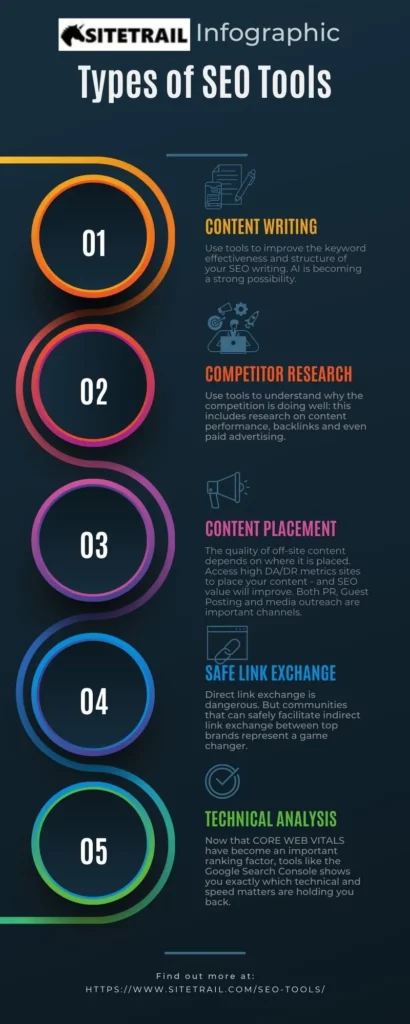
A compact overview of the main categories is available in this five types of SEO tools PDF.
How to keep an SEO tool stack current
Review the stack every quarter and after a material change in your site, team or search market. Record who uses each tool, which decision it supports, how frequently that decision occurs and what happened after the last three actions. Cancel products that duplicate another dataset or repeatedly produce reports nobody implements.
Recheck integrations and permissions at the same time. Remove former team members, use the least access required, document ownership of Search Console and analytics properties, and export information you must retain before changing plans. For AI research features, review whether uploaded information can contain customer, employee or confidential business data before it enters a third-party system.
Finally, maintain a small benchmark set: priority pages, representative queries, Core Web Vitals, qualified organic conversions, relevant referring domains, branded demand and selected AI-answer prompts. Consistent definitions make year-over-year comparisons more useful than chasing every new metric a vendor introduces.
Frequently asked questions about SEO tools
Can I do the Sitetrail SEO Course at no charge?
Check the current enrollment terms on the Sitetrail SEO Course page. Access conditions, modules and promotions can change. Regardless of price, use the course alongside a live site so every concept becomes a measured practical exercise.
How should I evaluate alternative SEO tools and services?
Start with the job to be done, not a feature count. Compare publication relevance, editorial controls, data provenance, workflow speed, reporting, support, contract terms and total cost. For guest-posting and distribution comparisons, review our pages on an alternative to Adsy, an alternative to iCopify, an alternative to Backlinked and an alternative to WhitePress.
Run a limited test with predefined acceptance criteria. Do not compare providers using domain metrics alone; inspect the actual sites, articles, audience fit, disclosures and referral potential.
Where can I find the best SEO data?
Use Search Console for your Google Search performance and index status, analytics for on-site behavior and conversions, and a reputable third-party database for competitors and market discovery. Combine the sources at page and query level. There is no single “best” dataset for every question.
What are the best SEO tools for agencies?
Agencies usually need one broad platform such as Semrush, Ahrefs, Moz Pro or SearchAtlas; Search Console access for each client; a dependable technical crawler; and reporting tied to qualified leads or revenue. Publishing and digital PR resources matter when the agency is accountable for implementation rather than recommendations alone.
Which tool is best for on-page SEO?
For WordPress controls, Yoast is a strong foundation. Surfer can help with search-informed content coverage, while a crawler or site auditor detects template and internal-linking issues across many URLs. The best combination depends on whether the problem is editorial, technical or structural.
Are free SEO tools any good?
Yes. Search Console, PageSpeed Insights and Google Trends can support serious SEO work. Free tiers from commercial platforms are also useful for limited research. Paid tools become worthwhile when they provide competitor coverage, scale, history, automation or collaboration that saves more time than the subscription costs.
Which are the best SEO services to use?
Choose a service whose capabilities match the constraint: technical SEO for crawling and indexation problems, content strategy for weak topic coverage, digital PR for authority and brand discovery, and conversion work when traffic fails to produce revenue. Our SEO packages explain available Sitetrail options. Ask every provider for scope, assumptions, approval controls, measurement and ownership terms.
Can DIY SEO tools make a difference?
Yes, particularly on a smaller site with a focused owner. A DIY stack can uncover indexation errors, improve page titles, answer neglected customer questions and track progress. Bring in a specialist when migrations, international targeting, JavaScript rendering, large-scale duplication, manual actions or material revenue risk make experimentation expensive.
Does SEO ranking report software help?
Rank tracking helps reveal direction, page movement and competitor changes for a controlled keyword set. It becomes misleading when a report treats one location, device and result layout as universal. Report landing-page clicks, conversions and share of relevant visibility alongside positions.
What is SEO Optimizer?
“SEO optimizer” is a generic label used for tools that review a page and recommend changes to metadata, headings, copy, links or technical elements. Evaluate the specific product’s data source and methodology. Optimization is the process of improving relevance, accessibility and usefulness—not reaching an arbitrary tool score.
What is SEO Minion?
SEO Minion is commonly known as a browser-based SEO utility for quick checks such as on-page elements, links and search-result observations. Browser extensions are convenient for spot checks but do not replace a full crawl, first-party performance data or manual template testing.
What are Mac SEO tools?
Mac SEO tools are platforms or desktop applications compatible with macOS. Most cloud suites work in a browser, while desktop products such as SEO PowerSuite offer Mac editions. Check operating-system requirements, memory use, project storage, update policy and export compatibility before choosing desktop software.
What are enterprise SEO tools?
Enterprise SEO tools are built for large sites, many markets and multiple teams. They emphasize crawling at scale, permissions, integrations, change monitoring, forecasting and governance. The buying decision should include data retention, API limits, security, implementation effort and support—not only the feature demonstration.
Final verdict
Update your knowledge with the Free SEO Course + Certification, establish your Search Console baseline, then choose tools around the decisions you need to make. ChatGPT can accelerate analysis and workflow design; Semrush, Ahrefs, Moz Pro or SearchAtlas can supply broader market intelligence; and focused tools can handle performance, WordPress controls, content coverage or backlinks.
The durable advantage is not owning more dashboards. It is turning trustworthy evidence into useful pages, technically sound experiences, credible third-party recognition and measurable customer outcomes—then repeating that process consistently.