
The WordPress chatbot market has changed more in the past two years than it did during the previous decade. As one researcher explained, From Chatbot to Digital Colleague: The Paradigm Shift Toward Persistent Autonomous AI.
Early chatbot plugins were relatively simple. They displayed a floating button, presented a list of predetermined questions and sent contact details to the website owner. Some added keyword matching, while others connected to live-chat operators. They were useful, but few people confused them with genuine intelligence.
The arrival of large language models changed expectations almost overnight. Website owners stopped asking whether a chatbot could display a menu and started asking whether it could understand the entire website, discuss products accurately, qualify prospects and resolve support questions without human intervention.
That transition created several different categories of product that are often compared as though they are identical.
Our comparison of AI Live Chat PRO, Tidio and AI Engine illustrates three distinct approaches. Tidio evolved from live chat into a broader customer-service platform, combining AI with human agents, ticketing and multiple communication channels. AI Engine approached the market from the opposite direction, becoming a broad WordPress AI toolkit covering chatbots, content creation, model integrations and developer tools.
The comparison between AI Live Chat PRO, WPBot Pro and Botpress reveals another side of the industry. WPBot Pro represents the mature WordPress chatbot model, with a large collection of modules for forms, retargeting, WooCommerce, social messaging and live operators. Botpress represents the emerging agent-development model: a cloud platform where developers can construct complex workflows, connect external systems and program highly customized AI behaviour.
None of these approaches is inherently wrong. They reflect different stages in the industry’s development.
The first stage was the scripted chatbot. These systems relied on buttons, keywords and decision trees. They were predictable but limited.
The second stage was the live-chat platform. Automation handled simple questions, while human agents took over complex cases. This remains highly valuable for companies with dedicated support teams.
The third stage was the general-purpose AI wrapper. WordPress plugins began connecting websites to ChatGPT and similar models. This made conversations more natural, but it introduced a serious weakness: fluent answers were not necessarily accurate answers.
A language model could confidently invent a price, recommend a product that did not exist or provide a believable but broken URL. For a personal blog, such errors might be embarrassing. For an ecommerce or service business, they could directly damage trust and revenue.
This problem led to the current stage: grounded AI assistants.
Instead of relying mainly on the model’s general training, grounded systems retrieve information from an approved knowledge base before generating an answer. The quality of the retrieval layer becomes as important as the model itself.
This is where many current products still differ significantly. Some crawl public pages. Others connect to uploaded documents. More advanced systems use embeddings, structured databases or live API calls. The strongest approaches combine several methods because website information is rarely stored in one neat format.
A WooCommerce product may contain a structured price and SKU. A service package may be described inside an Elementor pricing table. A refund policy may live on a normal WordPress page. Order status must come from live store data rather than a cached article.
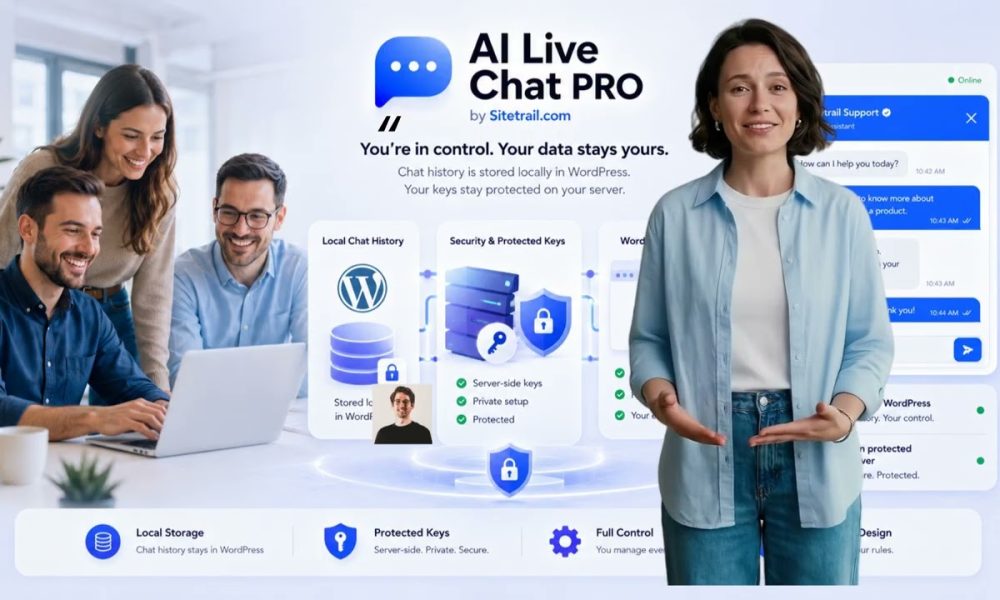
The shortcomings of earlier chatbot systems helped shape AI Live Chat PRO. It was created around questions that generic AI widgets did not always answer well: How can a chatbot avoid inventing commercial facts? How can it distinguish a new product question from a follow-up about the previous one? How can a guest safely check an order? How can conversation data remain under the website owner’s control?
Lead handling has evolved as well. Traditional plugins often treated every submitted email address as a lead. Modern businesses need more context. A genuine buyer, an existing customer, a vendor pitching services and an automated spam submission should not all enter the same queue with equal priority.
This is why Lead Scoring is becoming part of the chatbot itself. Rather than simply collecting contact information, the system can examine the conversation, classify intent and provide a confidence level and supporting reason. That classification can then influence reporting, support alerts and human handover.
Human handover is also changing. It no longer has to mean opening a separate ticket with no context. A conversation can move into WhatsApp with its existing history, allowing the visitor and business to continue without repeating the entire discussion.
The chatbot industry is therefore moving beyond the question, “Can it talk?”
The more useful questions now concern accuracy, data ownership, retrieval quality, ecommerce integration, qualification and continuity between AI and humans.
The comparison articles linked above show that the market is not converging on one universal product. It is dividing into specialized tools: helpdesk platforms, WordPress chatbot suites, developer agent platforms and grounded commercial assistants.
That specialization is a sign of maturity. The winning chatbot will not necessarily be the one with the longest feature list or the most advanced model. It will be the one whose architecture best matches the job the website actually needs it to perform.