
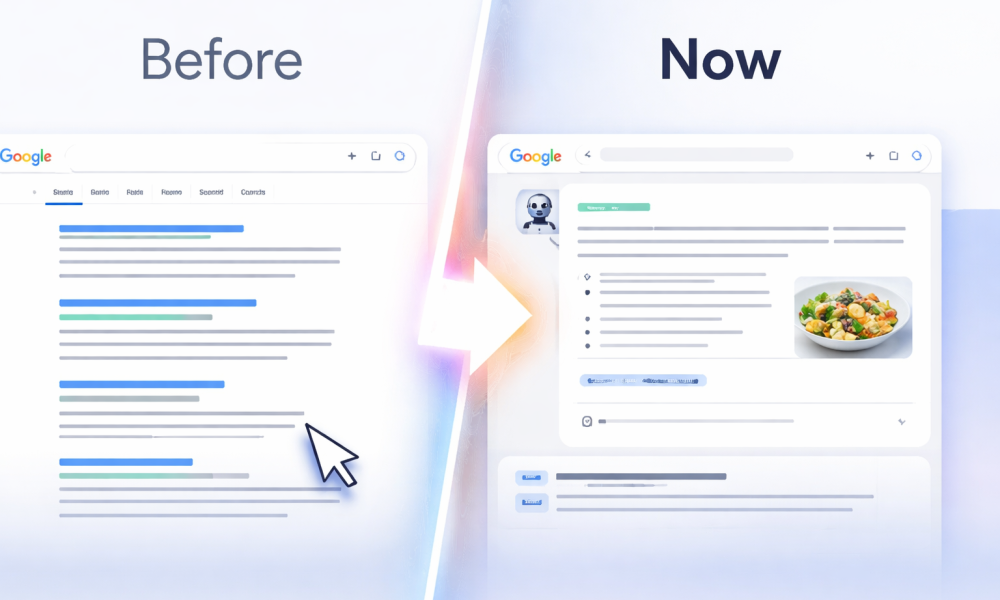
The way people discover information online has fundamentally changed—and the scale of this shift is massive. AI-powered search features are reducing click-through rates by 60% to 70% on queries where answers are generated directly on the results page, meaning the majority of users never visit a website at all. At the same time, large platforms have reported traffic drops in the hundreds of millions of visits per year as users move from traditional search into AI tools.
What used to be a predictable flow of search traffic is now being replaced by a model where AI delivers the answer instantly—and only a small fraction of users continue beyond it. This is not a gradual evolution. It is a structural shift in how visibility, influence, and customer acquisition now work online.
To remain competitive, businesses must adapt not just their content, but their entire visibility strategy across AI ecosystems:
1. Move Beyond SEO and Start Owning AI Answers
Ranking on Google is no longer enough. The real opportunity now is to become the source AI tools rely on.
This means:
- Structuring content for direct answers, not just rankings
- Writing in natural, conversational language
- Targeting long, highly specific user queries
But there is a second, more powerful layer emerging:
Instead of waiting to be discovered, you can own the AI interface itself.
Taking action – Build your own AI presence with a dedicated expert model:
https://www.sitetrail.com/product/custom-gpt-creation-service-chatgpt/
This turns your business into a persistent advisor inside AI platforms, not just another website competing for clicks.
2. Break Content into AI-Extractable “Answer Blocks”
AI systems don’t read like humans. They extract.
To be selected:
- Use clear sections answering specific questions
- Add summaries, bullet points, and FAQs
- Make every section standalone and usable
Think less like a writer and more like a data source AI can confidently quote.
3. Build Authority Clusters, Not Just Pages
AI favors entities that demonstrate deep, consistent expertise.
Winning strategies include:
- Creating topic clusters around core themes
- Publishing guides, research content, and educational material
- Supporting users at the research stage, not just purchase stage
But authority alone is not enough anymore.
You must actively feed and reinforce the signals AI learns from.
Take Action:
- Create your own citation footprint and influence how AI understands your brand:
https://www.sitetrail.com/newspass - Use the Generative Engine Optimization Portal GPT to guide you through the process: https://chatgpt.com/g/g-690602760cd8819196c6c1cfd14c46a8-generative-engine-optimization-portal
This allows you to build repeatable information patterns across trusted sources, effectively “coaching” AI systems on what to associate with your business.
4. Optimize for Trust, Not Just Visibility
AI models prioritize credibility over cleverness.
To increase your chances of being cited:
- Earn links from trusted, relevant sources
- Reference authoritative external material
- Show authorship, expertise, and editorial consistency
The reality:
AI does not guess trust. It aggregates it.
5. Focus on Problem-Solving Content
AI prefers decisive, helpful answers over vague descriptions.
Shift your approach:
- Show how solutions solve real problems
- Provide comparisons and clear recommendations
- Use “best option” or “top choice” formats where appropriate
Content that removes uncertainty is far more likely to be surfaced.
6. Structure for Machine Readability
Clarity wins.
Your content should:
- Use short paragraphs and logical headings
- Include structured lists and summaries
- Be easy to scan, extract, and recombine
AI is not impressed by style.
It rewards clarity, structure, and usability.
7. Accept the New Reality: Less Traffic, More Influence
AI reduces clicks, but increases influence.
What changes:
- Lower raw traffic from search
- Higher intent from visitors who do click
- Increased indirect visibility through AI mentions
The goal is no longer just traffic.
It is being embedded in the decision-making process before the click even happens.
Final Perspective
The future of digital visibility belongs to those who control three layers:
- The content AI reads
- The citations AI trusts
- The interfaces AI users interact with
Most businesses are still fighting for rankings.
The smarter ones are:
- Building their own AI assets
- Engineering their own citation ecosystems
- Positioning themselves as the default expert in their niche
If you are not shaping how AI understands your business,
you are leaving that narrative to your competitors.