
For years, website owners have been told that SEO starts with the same familiar checklist: install an SEO plugin, write a title tag, add a meta description, generate a sitemap, use schema, improve internal links, and make sure the page is indexable.
That advice is not wrong.
But it is no longer enough.
The way content is discovered, interpreted and reused has changed dramatically. Search engines are no longer the only gatekeepers. AI assistants, answer engines, search snippets, knowledge panels, content crawlers, social platforms, automated summarizers, browser tools and large language models now influence how people discover brands, products, experts, publishers and businesses.
This shift has created a new question for website owners:
Is your content merely published, or is it actually visible, understandable and useful to the systems that now shape discovery?
That is why we built Content Visibility.
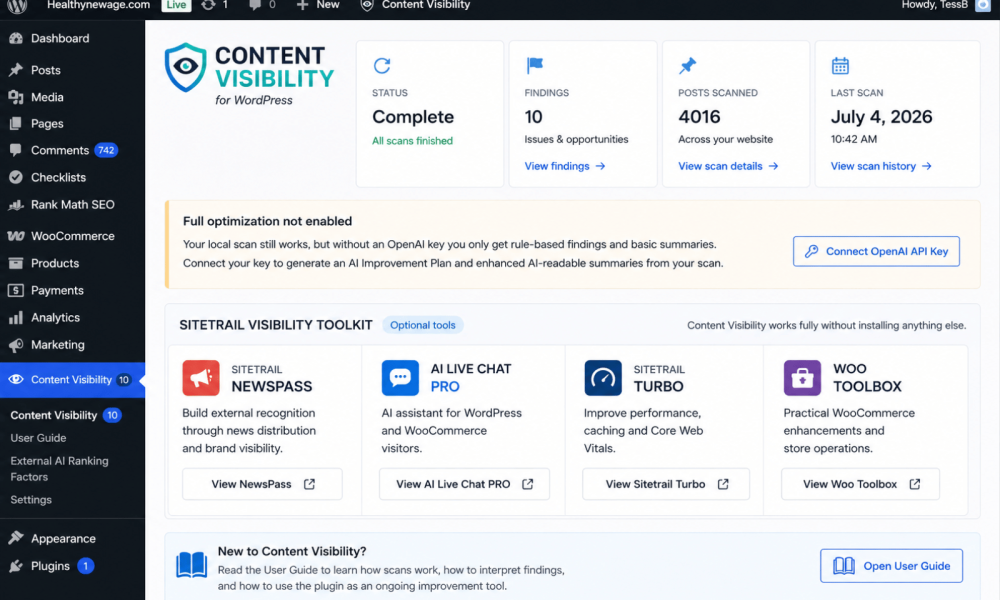
Content Visibility is a WordPress plugin from Sitetrail designed to help website owners think beyond traditional SEO fields and start addressing a much larger issue: whether the right content on a website is visible, accessible, readable and positioned for modern discovery.
You can learn more about the plugin here: Content Visibility Generative Engine Optimization for WordPress.
The old SEO plugin model was built for a different internet
The classic SEO plugin model solved a real problem.
WordPress, by itself, was never perfect for search engine optimization. Website owners needed better control over titles, descriptions, canonical URLs, XML sitemaps, robots settings, Open Graph data, schema markup and technical SEO signals.
That is why SEO plugins became essential.
They helped millions of website owners avoid obvious technical mistakes. They made it easier to tell Google what a page was about. They helped publishers and businesses improve how pages appeared in search results. They gave non-technical users a simple interface for managing the basics of on-page SEO.
But the internet those plugins were originally built for was simpler.
A website owner published a page. Google crawled it. The page appeared in search results. A user clicked. The website earned the visit.
That model still exists, but it is no longer the whole story.
Today, the user may never see a traditional blue link. They may ask an AI assistant. They may receive an answer compiled from multiple sources. They may see a search-generated summary. They may read a citation, a snippet, a panel, a comparison, a product answer, or a brand mention generated from information gathered across the web.
In this environment, the old SEO question — “Is my page optimized?” — is too narrow.
The better question is:
Can machines, platforms and people clearly understand which parts of my website matter, what those parts say, and why they should be trusted?
Visibility is not the same as indexing
A page can be indexed and still fail.
It can appear in a sitemap and still be misunderstood.
It can have a perfect title tag and still bury the most important information under scripts, design blocks, shortcodes, tabs, accordions, widgets, popups, templates or thin page structure.
It can have schema and still fail to explain the business properly.
It can have a green SEO score and still be weak for AI discovery.
This is the core problem.
Traditional SEO plugins are often focused on metadata. Content Visibility is concerned with a broader question: what is actually visible and useful?
That distinction matters.
Search engines and AI systems are increasingly retrieval-driven. They are looking for clear, reusable, trustworthy information. They need content that can be parsed, summarized and connected to entities, products, services, locations, people and topics.
A page that looks polished to a human visitor may not be equally clear to crawlers or AI systems. A homepage may look beautiful while failing to explain what the company does in a plain, extractable way. A service page may rank poorly not because the meta title is bad, but because the important claims are buried inside design-heavy sections that do not communicate well outside the visual layout.
The modern visibility problem is not only technical.
It is structural.
It is editorial.
It is strategic.
Why old SEO plugins are no longer enough
Old SEO plugins still have value. They are not obsolete. Website owners should still care about page titles, descriptions, canonical tags, XML sitemaps, schema, redirects, breadcrumbs, robots settings and technical SEO hygiene.
But these tools were not designed to solve the entire modern discovery problem.
Here is where the traditional SEO plugin model falls short.
1. They focus heavily on pages, not knowledge
Most SEO plugins treat each WordPress post or page as a separate unit.
That made sense in the old search model. But modern discovery systems do not only evaluate pages. They try to understand topics, entities, claims, relationships and authority across an entire site.
Your website is no longer just a collection of URLs.
It is a knowledge source.
That means your content must be clear enough for systems to understand what your business does, who it serves, what it offers, what it knows, and why it deserves to be referenced.
A title tag cannot solve that alone.
2. They optimize snippets, not full understanding
A meta description may influence how a page is summarized in some contexts, but it does not guarantee that the full substance of the page is understood.
Modern systems may extract answers from body content, headings, product descriptions, FAQs, author bios, category pages, resource hubs, reviews, documentation and internal knowledge sections.
The question is not only “What will Google show under my link?”
The question is:
What will a discovery system understand after reading this website?
3. They give a false sense of completion
Many website owners believe that once an SEO plugin is installed, the site is “SEO ready.”
That is dangerous.
A plugin can generate metadata, but it cannot automatically fix unclear positioning, weak content architecture, hidden information, poor topical coverage, thin pages, confusing service descriptions or missing trust signals.
Modern visibility requires more than filling in fields.
It requires making sure the right content exists, is accessible, is written clearly, and can be interpreted by both humans and machines.
4. They were not designed around AI readability
Large language models and AI search systems process content differently from a traditional search result page.
They look for clarity, consistency, context and extractable meaning. They may compare your content with other sources. They may identify whether your brand is consistently associated with a topic. They may favor content that is easier to summarize accurately.
A page can be technically indexable but still poor for AI readability.
That gap is becoming more important every year.
5. They often ignore the visibility of dynamic or design-heavy content
Modern WordPress websites are rarely simple text pages.
They are built with page builders, blocks, reusable templates, dynamic content areas, sliders, tabs, accordions, shortcodes, product widgets, membership sections, custom post types and third-party embeds.
That creates a visibility challenge.
The content a human sees on the front end may not always be presented in the cleanest possible way for crawlers, AI systems or automated tools. Important information can become fragmented, duplicated, buried or unclear.
Traditional SEO plugins usually do not treat that as their core problem.
Content Visibility was built because that problem deserves its own layer.
The rise of AI search changed the job of every website
SEO used to be mostly about ranking.
Now, visibility is broader than ranking.
A brand can be discovered through:
- Traditional Google search results
- AI-generated search answers
- Chatbot recommendations
- Browser-based AI summaries
- Product comparison tools
- Review aggregators
- News and content syndication
- Knowledge graph-style entity recognition
- Voice search
- Social search
- Industry-specific databases
- Automated research tools
- Internal company AI assistants
- Large language model retrieval systems
This means every serious website now needs to think like a publisher, a database, a brand entity and a knowledge source.
That is a major shift.
A business that depends only on classic SEO fields may become technically optimized but strategically invisible.
The new challenge is not just to rank for keywords.
It is to be understood.
It is to be cited.
It is to be summarized correctly.
It is to make sure the most important information on your website is not trapped inside a layout that only makes sense visually.
It is to help both people and systems recognize what your brand is about.
Content Visibility is a new layer for modern WordPress discovery
Content Visibility is not meant to replace every SEO plugin.
It is meant to address the layer that many older SEO tools do not fully cover.
The plugin exists because website owners need a better way to think about what is visible, what is useful, what can be interpreted, and what needs to be improved for the modern discovery environment.
In simple terms:
SEO plugins help you manage technical SEO signals. Content Visibility helps you think about whether your content is actually discoverable and understandable.
That makes it especially useful for websites that care about:
- AI search visibility
- Generative engine optimization
- Answer engine optimization
- Content clarity
- Website authority
- Brand discoverability
- Publisher visibility
- Service page quality
- Product and category page communication
- Local business visibility
- SaaS and B2B content structure
- Agency audits
- Editorial planning
- Search and AI readability
The goal is not to chase another vanity score.
The goal is to make the website more useful to the systems and people that decide what gets seen.
Why this matters for publishers
Publishers are under pressure from every direction.
Search traffic is changing. Social traffic is unreliable. AI summaries can answer user questions without sending the same volume of clicks. Newsrooms, niche publishers and content businesses need to make sure their content is not only published but clearly identifiable as useful, original and authoritative.
A publisher may have thousands of articles, but if the structure is messy, the topical signals are weak, or important editorial content is hard to interpret, visibility suffers.
Content Visibility helps publishers think beyond basic metadata and focus on the broader visibility of their editorial assets.
For publishers, this matters because the future of discovery may depend less on single-page optimization and more on how well a site communicates expertise across topics.
Why this matters for businesses
Most business websites fail at clarity.
They may have a beautiful homepage, but the actual message is vague. They may list services, but not explain them properly. They may use fashionable language that looks impressive but says very little. They may bury pricing, process, location, proof, case studies, FAQs or differentiators.
That is bad for users.
It is also bad for search and AI systems.
A modern business website should make it easy to answer questions such as:
- What does this company do?
- Who does it help?
- Where does it operate?
- What problems does it solve?
- What products or services does it offer?
- What evidence supports its claims?
- What should a user do next?
- Which pages contain the most authoritative explanation of each topic?
Old SEO plugins can help with metadata around these pages.
But they do not fully solve the content visibility problem.
Content Visibility helps business owners see the website as an information system, not just a design asset.
Why this matters for ecommerce
Ecommerce sites have their own visibility problems.
Product pages are often thin. Category pages may have little useful explanatory content. Important buying information may be hidden inside tabs. Reviews, FAQs, specifications, shipping information, return policies and comparison content may not be clearly presented.
In a world of AI-powered shopping assistants and product comparison engines, ecommerce visibility will increasingly depend on the clarity of product and category information.
A product page that only works visually may not be enough.
A category page that lists products but gives little context may not be enough.
A store that relies on old SEO settings while ignoring content depth and machine readability may struggle to compete.
Content Visibility gives ecommerce site owners another way to think about the information layer behind the store.
Why this matters for agencies
Agencies are often asked to improve “SEO,” but clients usually do not understand what that means anymore.
Many clients still think SEO is a checklist. Install a plugin. Add keywords. Submit a sitemap. Wait for results.
That model is outdated.
Agencies now need to explain visibility in a more sophisticated way. They need to show clients that modern optimization includes content architecture, entity clarity, AI readability, topical authority, public-facing trust signals and machine-readable explanations.
Content Visibility can support a more modern agency conversation.
Instead of only saying, “Your title tags need work,” an agency can say:
Your website does not make its most important information visible enough for the way modern discovery systems work.
That is a stronger and more strategic conversation.
It also reflects where the industry is heading.
The SEO industry needs to widen the definition of optimization
The SEO industry has always evolved.
At one point, keyword stuffing worked. Then it did not.
At one point, exact-match domains were more powerful. Then the market changed.
At one point, directory links and low-quality guest posts worked better than they should have. Then search engines improved.
At one point, technical SEO alone could create a major advantage. Today, technical SEO still matters, but it is only one part of a much broader visibility system.
Now the next shift is already underway.
Optimization is no longer just about helping a search engine crawl a page.
It is about helping multiple discovery systems understand a brand, a website, a product, a person, a service, a claim, a topic and a body of knowledge.
That is a much bigger job.
And it requires tools that go beyond the old model.
Content Visibility and the future of AI visibility
There is a reason terms such as AI SEO, generative engine optimization, answer engine optimization and AI visibility are becoming more common.
The industry is trying to describe a new reality.
People are no longer discovering information through one interface. They are asking systems to interpret the web for them.
That means websites must become easier to interpret.
This does not mean chasing tricks.
It does not mean stuffing pages with “AI keywords.”
It does not mean trying to manipulate language models.
It means doing the fundamentals better:
- Make important content visible.
- Make explanations clear.
- Make pages useful.
- Make the site structure logical.
- Avoid burying key information.
- Strengthen topical coverage.
- Improve internal clarity.
- Present trust signals in a way that can be understood.
- Treat the website as a source of knowledge, not just a collection of landing pages.
That is the philosophy behind Content Visibility.
This is not anti-SEO plugin. It is post-checklist SEO.
Content Visibility is not an argument against traditional SEO plugins.
Many websites should still use a classic SEO plugin. Technical SEO still matters. Sitemaps still matter. Canonicals still matter. Schema still matters. Metadata still matters.
But the industry needs to be honest:
A site can have all of those things and still fail to communicate clearly.
A site can pass a checklist and still be invisible where it matters.
A site can be indexed and still not be understood.
That is why the next generation of WordPress optimization needs an additional layer.
Content Visibility is part of that next layer.
It is built for website owners, publishers, agencies and businesses that recognize the shift from old SEO to modern discoverability.
The websites that win will be the ones that are easiest to understand
The future of search will not reward confusion.
Whether a person is reading a page, a search engine is crawling it, or an AI system is summarizing it, clarity matters.
The websites that win will likely be the ones that make their expertise obvious, their information accessible and their value easy to extract.
That is not just an SEO issue.
It is a business issue.
It is a publishing issue.
It is a brand issue.
It is a visibility issue.
Content Visibility was created for that reality.
If you run a WordPress website and you are serious about being discovered in the modern search and AI environment, it is time to look beyond the old SEO checklist.
It is time to ask whether your content is truly visible.
Learn more here: Content Visibility for WordPress.