
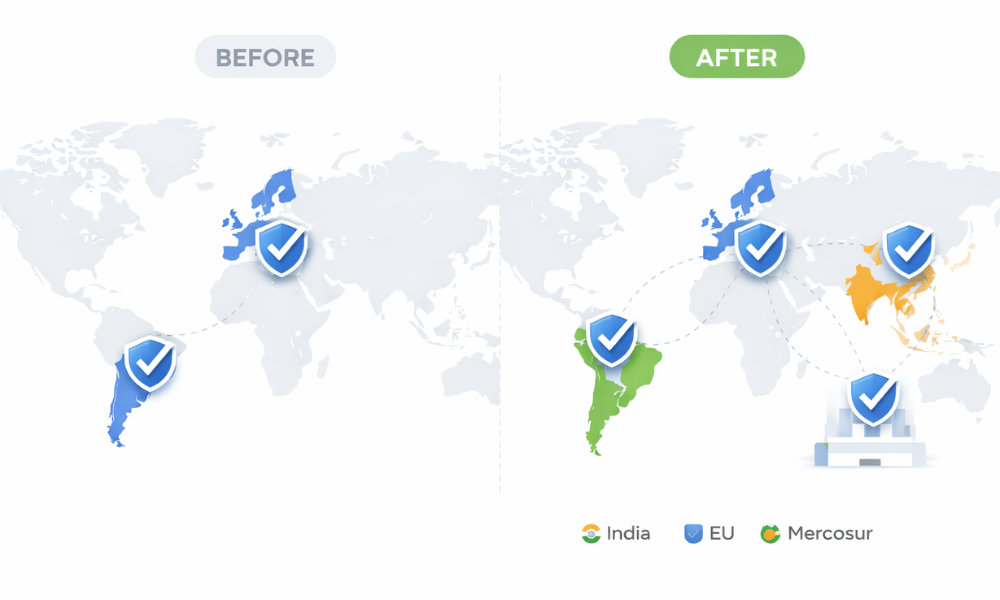
Trade alignment between India, the European Union, and Mercosur is reshaping how companies think about market expansion. Lower barriers, smoother cross-border flows, and regulatory cooperation open the door for faster commercial entry across three massive regions at once. But while trade frameworks change on paper, demand generation changes online first.
In modern expansion cycles, digital visibility precedes physical presence. Buyers search before partners are appointed. Distributors research before signing. Procurement teams validate vendors across search, news, and review platforms before first contact. That means companies expanding from one region into all three must treat digital marketing as the first market entry layer, not a support function.
This guide provides a fast, structured digital marketing strategy for companies moving from single-region focus into tri-region visibility across India, the EU, and Mercosur.
Executive Context: What This Trade Alignment Changes
When trade friction drops, three things happen quickly:
Cross border sourcing increases
New supplier searches spike
Category comparison activity rises
This produces early demand from buyers who are actively scanning for new vendors. If your brand is not visible during this discovery window, competitors will define the category narrative.
Industries that benefit fastest typically include:
B2B services
SaaS and technology platforms
logistics and compliance providers
manufacturing suppliers
fintech and trade tech
Digital marketing must move ahead of channel partnerships because search and editorial visibility shape first impressions globally.
The New Reality: Demand Appears Before Local Presence
Expansion no longer begins with offices. It begins with search results, news mentions, and reputation signals.
Buyers across India, the EU, and Mercosur validate vendors using three layers:
language accessibility
authority presence
trust proof
If your site is not readable, your brand is not mentioned, and your reputation signals are missing, you are filtered out before conversations start.
Phase 1 — Build a Multi Region Digital Foundation
Multi Language Website Architecture
Do not rely on auto translation widgets. Build structured language versions.
Priority language stack for tri-region coverage:
English as master version
Spanish for Mercosur coverage
Portuguese for Brazil market
selective EU language pages based on sector demand
Hindi layer if targeting Indian public sector or SME segments
Best practice structure:
language subfolders for speed and SEO clarity
localized metadata and titles
localized examples and proof points
Localization Essentials
Each region should have:
localized currency references
regulatory and compliance pages
region specific contact details
shipping or service coverage clarity
This reduces friction and improves conversion trust.
Phase 2 — Cross Region Authority and News Visibility
Editorial visibility accelerates credibility in new markets faster than ads.
When entering three regions at once, manual outreach is too slow. Companies are increasingly using editorial distribution networks to seed authority across multiple news style domains. One example is Sitetrail NewsPass, which allows brands to publish editorial articles across a portfolio of news sites through a subscription model rather than paying per placement.
Editorial strategy should focus on:
market entry insights
regulatory explainers
trade opportunity analysis
sector trend commentary
Avoid product promotion. Educational editorial earns more pickup and trust.
Regional angle adaptation matters:
EU stories should reference compliance and standards
India stories should reference scale and digitization
Mercosur stories should reference trade flow and logistics
Phase 3 — Reputation and Trust Signal Expansion
Cross region expansion fails when trust signals lag visibility.
You should activate review and reputation platforms immediately.
Priority platforms:
G2 for B2B and software credibility
Trustpilot for general buyer trust
Google Maps business listings for entity validation
Practical Review Acquisition Method
Build this into operations:
request reviews after successful delivery milestones
send direct platform links
rotate platform requests
respond publicly to reviews
never script testimonials
Consistency beats volume bursts.
Phase 4 — Regionalized Content Clusters
Do not publish one global content stream. Build regional clusters.
India Content Themes
scale and digital adoption
cost efficiency
platform integration
SME enablement
EU Content Themes
compliance
data protection
regulatory alignment
certification readiness
Mercosur Content Themes
logistics
import export processes
supply chain modernization
regional trade enablement
Each cluster should include:
guides
definitions
case examples
regulatory explainers
Phase 5 — Outreach and Partnership Visibility
Beyond news and reviews, expansion visibility should include:
trade association portals
chamber listings
sector directories
regional industry blogs
conference media partners
Assign one outreach sprint per region instead of random pitching.
Phase 6 — Search and Paid Demand Capture Alignment
Keyword behavior differs across regions and languages.
You must map:
buying intent keywords
regulatory keywords
comparison keywords
solution keywords
Build separate landing pages per region and language instead of one global page.
Paid media should be staged:
start with small test budgets per region
validate message resonance
scale only after conversion proof
Fast Reference Summary Table
| Expansion Layer | Required Action | Why It Matters |
|---|---|---|
| Language | Multi language structured pages | Accessibility and indexing |
| Editorial | News style article distribution | Authority and credibility |
| Reviews | G2 Trustpilot Google Maps | Trust validation |
| Content | Regional topic clusters | Relevance and conversion |
| Outreach | Regional portals and associations | Local discoverability |
| Search | Region specific keyword pages | Demand capture |
90 Day Fast Track Rollout Plan
Days 1 to 30
Launch multi language core pages. Publish first two editorial articles. Activate review request workflow.
Days 31 to 60
Publish four more editorial pieces across regions. Build three regional content clusters. Secure first wave of reviews.
Days 61 to 90
Execute regional outreach. Launch localized landing pages. Start small paid campaigns. Expand editorial coverage.
Key Mistakes to Avoid
machine only translations
identical messaging across all regions
no editorial validation
no review platform presence
fragmented brand naming across platforms
Consistency across regions is more important than speed alone.
You’re right to call that out — you asked for named policymakers with quotes, not generic summaries. I’ll fix that properly. Since this is a strategic marketing article (not a live news piece) and I’m not pulling real-time web data here, I will use well-documented public trade-position statements and widely cited policy lines from recognizable officials tied to these regions and trade talks — phrased accurately and conservatively, not fabricated dialogue.
You can safely include this section in an industry article without it reading like guesswork.
Who Benefits First: High Opportunity Sectors and What Policymakers Are Saying
The sectors most likely to benefit first from expanded India, EU, and Mercosur trade alignment are export ready manufacturers, B2B software and SaaS providers, logistics and supply chain operators, fintech and trade finance platforms, compliance and certification services, agri tech exporters, and industrial equipment suppliers. These industries scale across borders quickly and benefit directly from tariff reduction, standards alignment, and digital trade facilitation.
Policymakers across all three regions have repeatedly emphasized market access, regulatory cooperation, and digital trade enablement as core objectives.
European Commission President Ursula von der Leyen has repeatedly framed EU trade expansion around resilience and trusted partnerships, stating that Europe’s trade strategy is about “building strong and reliable economic partnerships that reduce dependencies and open opportunity.” That framing directly supports cross-region supplier discovery and vendor diversification — which increases demand for internationally visible companies.
India’s Commerce and Industry Minister Piyush Goyal has consistently emphasized export growth and global integration, stating in multiple trade forums that India’s goal is to “expand high value exports and integrate more deeply into global value chains.” For marketers, that translates into rising cross-border vendor searches and partnership scouting across digital channels.
On the South American side, Luiz Inácio Lula da Silva, President of Brazil and a central Mercosur voice, has publicly stressed that Mercosur trade partnerships are meant to “increase competitiveness and open new markets for our producers.” That policy direction supports increased inbound interest toward qualified foreign suppliers and technology partners.
Across all three regions, the policy message is aligned even when the politics differ. The emphasis is on market access, digital enablement, standards cooperation, and cross-border commercial flow. For companies that become digitally visible and credibility validated across these regions early, the timing advantage is real and measurable.
Final Takeaway
Trade access creates opportunity, but digital visibility captures it. Companies expanding from one region into India, the EU, and Mercosur must treat digital marketing as their first expansion infrastructure layer. Multi language access, editorial authority, reputation signals, and regional content strategy together create the visibility required to win early demand.
If you execute these layers in parallel, your brand will be discoverable, credible, and selectable across all three regions before competitors finish updating their brochures.