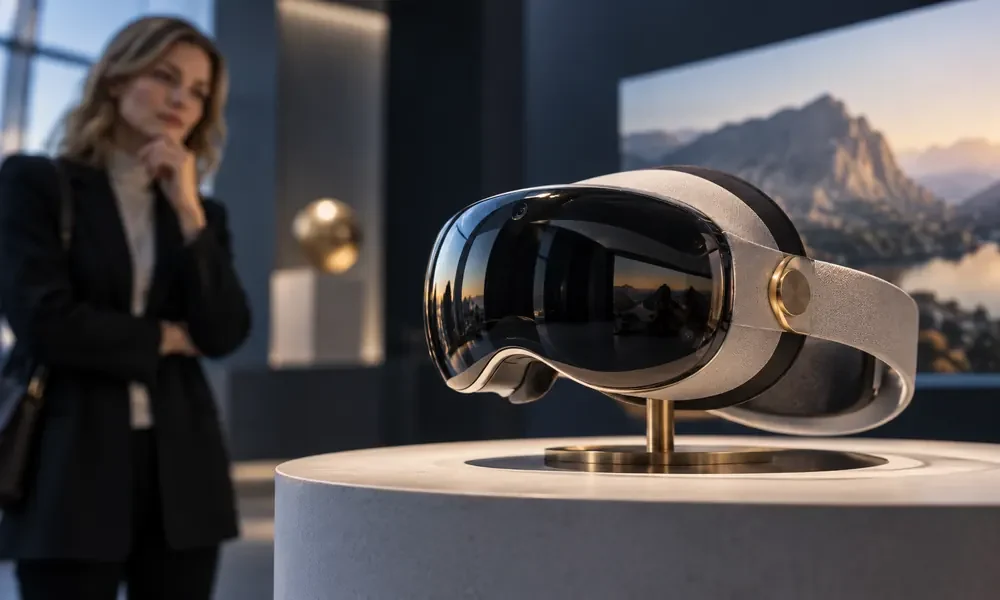
Apple staged Vision Pro carefully: early announcement, developer lead time, in-store trial and a single-market start. Estimates suggest adoption stayed modest.
Apple is famous for launches. Apple Vision Pro is a useful one to study precisely because the launch was carefully built and the commercial result appears to have been modest.
That gap is the lesson. A well-structured launch can create attention, access and trial. It cannot, on its own, make a product fit enough buyers at its price.
The structure, step by step
Apple’s own announcements set out the sequence clearly.
Announce early, with the price. Apple unveiled Vision Pro on 5 June 2023. It gave the US starting price of $3,499 and said the product would be available “early next year”, with more countries “later next year.”
Give developers time. Announcing about eight months before sale gave app makers time to prepare. Apple’s January 2024 announcement said more than 1 million compatible iPhone and iPad apps would be available, alongside apps built for the new device.
Make trial physical. Apple said in 2023 that customers would be able to “learn about, experience, and personalize their fit” in Apple Stores. For a face-worn device, the fitting and the demo were part of the product.
Launch in one market first. Apple’s January 2024 release set pre-orders for 19 January and availability on 2 February 2024, in the US only, through Apple Stores and its US online store.
Expand, then iterate. By October 2025, Apple introduced an upgraded Vision Pro with its M5 chip, a new headband and longer battery life, at the same $3,499 US starting price. It went on sale in 11 countries and regions on 22 October 2025.
Why this structure makes sense
The following is our analysis of the launch design, not Apple’s stated rationale.
Each step reduces a specific risk.
The early announcement tested interest and recruited developers before money was spent on stock. The single-market start limited the supply chain, retail training and support burden. The in-store demo answered the question most buyers had: what is it like to wear?
Keeping the price the same for the second model held the product’s premium position. It also meant the upgrade did not lower the barrier to entry.
What the results suggest
Apple does not publish Vision Pro sales figures. Any number comes from estimates, and should be treated with caution.
9to5Mac reported in January 2026 on a Financial Times article citing IDC estimates. IDC expected about 45,000 new Vision Pro units to sell in the 2025 holiday quarter, which included the launch of the M5 model.
Sitetrail NewsPass · SEO, PR & GEO
Build your search visibility, media presence and AI discoverability
Explore NewsPass for your SEO, PR and generative engine optimization strategy. Use the calculator to compare campaign costs and find a plan that fits.
Basic
$199/moSilver
$399/moGold
$599/moSee how NewsPass works
The same report cited Sensor Tower data suggesting Apple had cut digital advertising for Vision Pro by more than 95% in the US and UK. It also cited Counterpoint data showing a 14% decline in the wider VR headset market.
9to5Mac itself noted that these numbers are hard to verify. Even so, the direction is consistent: a carefully launched product that did not reach mass adoption at its price.
The shift toward business use
Apple’s October 2025 release devoted a section to professional and enterprise use.
It named CAE, the Canadian simulation and training company, using Vision Pro for pilot training outside specialised centres. It also cited Porsche showrooms and Visage Imaging’s work with UC San Diego Health on 3D medical imaging.
Apple also said more than 3,000 apps had been built specifically for visionOS, out of more than 1 million available.
We read this as a sign of where the product found clearer value: in training, design and specialist work, where a high price can be justified against a business outcome. That is an interpretation, not a statement from Apple.
Lessons for any launch
The structure is worth copying. The assumptions behind it are worth testing more harshly.
Separate attention from adoption. Launch coverage, demos and pre-orders show interest. Repeat use and repeat purchase show fit.
Name the price assumption. A premium price is a hypothesis about who will pay. State the segment and the volume that make it work before launch.
Stage the markets. Starting in one market is not caution for its own sake. It buys time to learn before the expensive rollout.
Watch for a segment shift. If the early traction comes from a different customer than planned, such as business buyers rather than consumers, follow the evidence.
Plan the second act. Apple’s upgrade improved the product without changing the price barrier. A second launch should address the main reason people did not buy the first time.
What a B2B or services team can borrow
Few companies launch a $3,499 headset. Many launch a new service tier, a premium package or a new market.
The same pattern applies. Announce to existing customers early, let them try it in a controlled way, launch where you can support it well, and then expand only when repeat use is proven.
The takeaway
Vision Pro shows that a disciplined launch can be built around a product that still struggles to find enough buyers. Planning the launch is the easier part. Testing the commercial assumptions behind it is the harder part, and the more valuable one.
Key takeaways
- Apple announced Vision Pro in June 2023 at $3,499, launched in the US only on 2 February 2024, and released an M5 upgrade at the same price in October 2025.
- Apple does not publish unit sales; third-party estimates reported in early 2026 suggest modest adoption, so treat the figures with caution.
- A disciplined launch structure creates attention and trial, but price and fit assumptions still need testing.
Put it into practice
For your next launch, write down separately how you will measure attention (coverage, demos, sign-ups) and adoption (repeat use, repeat purchase), and set a target for each.
A question for your next leadership meeting
Are we judging our last launch by the attention it created or by the adoption it achieved?