
For more than twenty years, marketers optimized for search engines that behaved in a familiar way. A user typed a query, Google returned a list of links, and the job was to earn visibility somewhere near the top of that page. The rules were never simple, but the basic model was clear: rankings, clicks, traffic, conversions.
That model is no longer the whole game.
Today, a growing share of discovery happens through generative systems. People ask ChatGPT, Gemini, Perplexity, Claude, AI Overviews, and other answer engines to summarize options, explain categories, compare providers, and recommend next steps. These systems do not simply return ten blue links. They synthesize. They cite. They compress the market into a handful of names. In many cases, they choose who gets mentioned and who disappears.
That shift creates a new problem for every serious business with a website.
It is no longer enough to ask whether a page can rank. The sharper question is whether a page can be accessed, understood, extracted, trusted, and cited by AI systems.
That is the problem GEO Scanner was built to expose.
GEO Scanner, short for Generative Engine Optimization Scanner, is a free browser extension that audits live webpages for AI search readiness. It is available for Google Chrome, Mozilla Firefox, and Microsoft Edge.
The tool is designed for the world marketers are now entering: a world where visibility depends not only on classic SEO signals, but also on whether generative systems can crawl a page, interpret its structure, understand its entities, extract useful answer fragments, and compare it against competing sources.
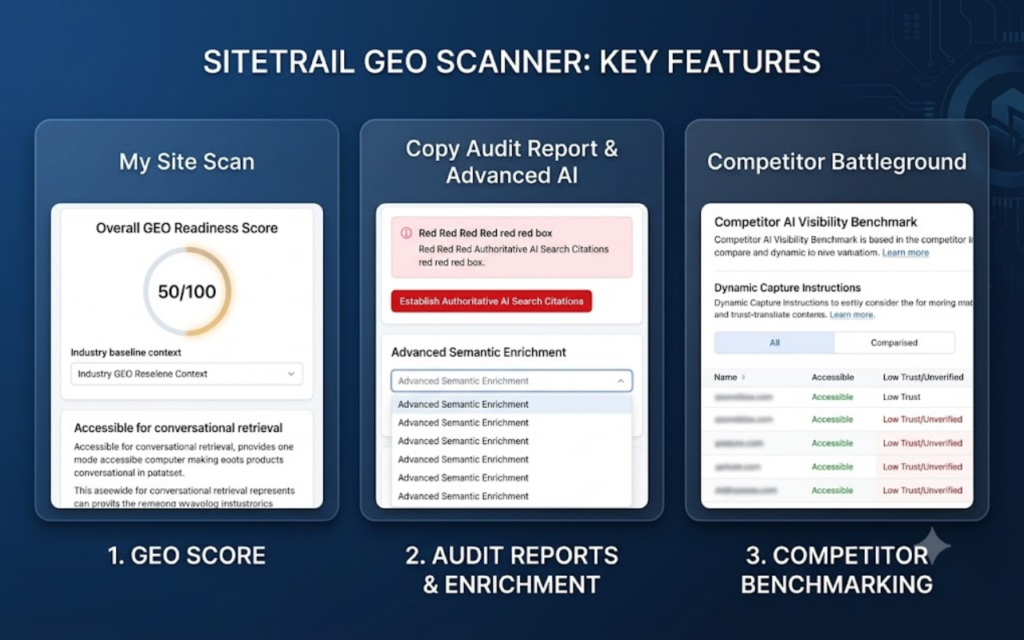
GEO Scanner turns that invisible readiness problem into something visible. Open a live webpage, click the extension, and the page is analyzed for practical Generative Engine Optimization signals. The scan looks at AI crawler access, robots.txt behavior, structured data, schema coverage, semantic heading structure, page chunkability, competitor readiness, and optional advanced semantic critique.
The result is not a vanity SEO score. It is a practical readiness audit for the new answer-engine layer of search.
That distinction matters. Traditional SEO tools are still useful, but most of them were built for the old interface: search result pages, keywords, backlinks, and ranking positions. GEO Scanner focuses on a newer question: if an AI system is building an answer in your category, are you technically and semantically prepared to be included?
Generative engines have introduced a harsher form of visibility.
In classic search, being in position five, eight, or twelve could still produce traffic. A brand could be present but not dominant. A buyer could scroll, compare, and choose. In AI search, the interface is more selective. The answer may mention three companies, five sources, or one recommended path. Many brands will not appear at all.
This creates a serious commercial risk. A company may continue publishing content, improving pages, and investing in SEO, while still failing to appear in AI-generated answers that influence buyers before they ever visit a website.
There are several ways this can happen.
A page may be blocked or restricted by robots.txt settings that limit access for AI-related crawlers. A site may have useful content but weak structured data, making the entity relationships harder to understand. A page may have poor heading hierarchy, making it difficult to extract clear answer sections. A business may explain itself well on its own website but lack the broader public authority that gives generative systems confidence when selecting sources.
GEO Scanner does not pretend that one extension can solve every one of those problems. What it does is make the first layer measurable.
That is the important starting point. Before a company can improve AI visibility, it needs to know whether its pages are even ready to be crawled, parsed, chunked, and evaluated.
Available on Chrome, Firefox, and Edge
One of the strengths of GEO Scanner is that it lives where the work already happens.
Chrome remains the default browser for many marketing teams, founders, SEOs, developers, and agencies. Firefox is still widely used by technical users, privacy-conscious teams, and people who prefer not to standardize around a single vendor ecosystem. Edge is common in Microsoft-heavy business environments and enterprise settings.
By supporting Chrome, Firefox, and Edge, GEO Scanner avoids a common adoption problem. It does not force a team to change browsers before it can run a scan. A founder can check a homepage in Chrome. An agency strategist can audit a prospect in Firefox. An enterprise marketing manager can review a page inside Edge.
The workflow is intentionally simple. Open a live HTTP or HTTPS page. Run the extension. Review the score. Check the structural findings. Compare against competitors. Export or copy the findings when needed.
That matters because GEO is still new for many organizations. A tool that requires a complex dashboard, onboarding call, or technical setup will often be ignored. A browser extension lowers the friction. It lets someone inspect the problem at the exact moment they are looking at the page.
GEO Scanner focuses on practical signals that affect whether a webpage is ready for generative discovery.
The first layer is AI crawler access. The extension evaluates robots.txt signals that may affect whether AI-related crawlers can access the site or page. If important crawlers are blocked, restricted, or treated inconsistently, that becomes an immediate visibility concern. Content that cannot be accessed cannot be evaluated or cited.
The second layer is structured data. GEO Scanner inspects JSON-LD and looks for important schema types such as Organization, Article, FAQPage, and Product. Structured data helps search and AI systems understand what a page is about, who published it, what entity is being described, and how the content should be interpreted. Without a clear schema graph, a page may still be readable to humans but less clear to machines.
The third layer is semantic structure. Headings are not only a design choice. They help divide a page into sections that can be extracted, summarized, and reused. A clean H1 and H2 structure gives machines a clearer map of the content. A messy or shallow structure makes the page harder to chunk into useful answer units.
The fourth layer is overall GEO readiness. GEO Scanner combines the main findings into a practical score that gives teams a clear starting point. The score is not meant to replace judgment, but it creates a shared language. Instead of vague statements like “we need AI SEO,” a team can look at specific gaps: crawler access, schema, headings, competitor readiness, and semantic clarity.
The fifth layer is competitor comparison. This is one of the most useful features because it turns GEO from an abstract concept into a visible competitive issue. A company can scan its own page, then scan a competitor’s page and compare readiness side by side. If a rival has cleaner schema, better structure, clearer AI access, and stronger page organization, the risk becomes obvious.
The sixth layer is optional advanced semantic critique. For teams that want deeper analysis, advanced mode can use supported on-device AI capabilities where available, or user-provided API keys for external models. The key point is that the core scan does not depend on handing over a full browsing history to a remote dashboard. The tool is built around a local-first workflow.
A Better First Step Than Guessing
The phrase “AI SEO” is already becoming crowded with vague advice. Some of it is useful. Much of it is recycled content marketing language with new labels attached.
GEO Scanner is valuable because it moves the conversation from slogans to inspection.
A marketing team does not need to start with a six-month theory about large language models. It can start by asking a few direct questions.
Can AI-related crawlers access this page?
Does the page contain structured data that clearly identifies the organization, article, product, service, or FAQ content?
Is the heading structure strong enough for clean extraction?
Would an answer engine understand what this page is about without guessing?
How does this page compare with a direct competitor?
Those questions do not solve every AI visibility problem, but they force the right conversation. They also prevent teams from wasting time on surface-level content work while technical and structural issues remain untouched.
For Founders and Executives
For founders, CEOs, and CMOs, the main value of GEO Scanner is clarity.
Most executives do not need another dashboard full of technical metrics. They need to know whether the company is prepared for the way buyers are now discovering information. They need to know whether competitors are easier for AI systems to understand and cite. They need to know whether their own content investment is structurally ready for the new search environment.
GEO Scanner gives them a simple artifact: a readiness score, a list of issues, and a competitor comparison. That can be used in planning meetings, content reviews, agency conversations, investor updates, or internal marketing discussions.
It also helps prevent a common mistake. Many companies will respond to AI search by producing more content. More content is not always the answer. If the existing site is difficult to crawl, poorly structured, or weakly marked up, publishing more pages may simply create more material that machines struggle to interpret.
The smarter first move is to inspect the foundation.
For SEO and Content Teams
For SEO professionals, GEO Scanner does not replace technical SEO. It extends it.
Good SEO teams already understand crawlability, internal structure, schema, headings, and entity clarity. What GEO Scanner does is reframe those skills for the answer-engine era. It shows how familiar technical elements affect AI retrieval and citation readiness.
For content teams, the tool can change how pages are planned and edited. A page should not only sound good to a human reader. It should also be organized in a way that allows machines to identify the core answer, extract useful sections, and understand the relationship between the brand, the topic, and the page’s purpose.
That does not mean writing robotic content. In fact, the opposite is true. The strongest pages are usually clear for both humans and machines. They explain the subject directly, use logical headings, define entities properly, answer important questions, and avoid burying the main point under vague marketing language.
GEO Scanner gives editors and SEO teams a fast way to see whether a page is moving in that direction.
For Agencies and Consultants
Agencies can use GEO Scanner as a practical discovery tool.
In a sales conversation, abstract talk about AI visibility can easily feel speculative. A live scan is different. It shows the client’s page, the competitor’s page, and the gap between them. That makes the issue concrete.
The white-label markdown report feature is useful for consultants who need to turn a scan into a client-facing summary. Instead of manually building a diagnostic from scratch, they can copy the findings into a proposal, audit, or strategic memo.
The strongest use case is not fear-based selling. It is evidence-based prioritization. A client may think they need more blog posts, a new landing page, or a backlink campaign. GEO Scanner may show that the first priority is cleaner schema, better headings, or fixing crawler access. That makes the agency conversation more useful and more honest.
For Ecommerce, SaaS, Local Services, and Publishers
Different categories face different GEO risks.
Ecommerce brands need product pages that are easy to understand, compare, and summarize. Product schema, clean descriptions, FAQs, and review signals can all affect how well a page fits into AI-assisted shopping journeys.
SaaS companies need clear positioning, strong feature explanations, use-case pages, integration pages, comparison pages, and entity consistency. If a generative engine cannot understand what the software does and who it is for, the company may lose visibility in high-intent recommendation queries.
Local service businesses face another challenge. As users ask AI systems for recommendations near them, the businesses that are easiest to understand and verify may gain an advantage. Clean service pages, location clarity, FAQ structure, and consistent business information become more important.
Publishers and editorial sites also need to pay attention. Generative systems often rely on pages that explain topics clearly and can be parsed into concise answer units. A strong article that is poorly structured may underperform as an AI source compared with a simpler but better-organized page.
In every case, GEO Scanner gives teams a way to inspect the page as a machine-readable asset, not only as a visual webpage.
Privacy and Local-First Scanning
Privacy matters in this category.
Many SEO and marketing tools collect large amounts of data in exchange for a free score. That model can be uncomfortable for agencies, enterprise teams, and anyone working with sensitive client information.
GEO Scanner is designed around local-first scanning. Core audit activity happens in the user’s browser. API keys, competitor snapshots, and scan data are stored locally where applicable. The product does not need to turn every audit into a remote data-harvesting event.
That architecture makes the tool easier to use in serious environments. Agencies can inspect client pages without treating every scan as a lead-generation submission. Internal teams can review pages without pushing unnecessary information into another vendor dashboard.
A Serious GEO Strategy Starts With the Page
There is a temptation to make Generative Engine Optimization sound mysterious. It is true that AI search introduces new complexity, but the starting point is often practical.
Can the page be accessed?
Can it be understood?
Can it be segmented into useful answer sections?
Can the brand and topic be identified clearly?
Can the page compete structurally with other pages in the same category?
These are not abstract questions. They are inspectable. They are fixable. They can be reviewed page by page.
That is why GEO Scanner matters. It gives teams a fast, visible way to begin the process without waiting for a full platform, expensive audit, or vague strategy document.
The companies that benefit most from AI search will not be the ones that simply use the newest terminology. They will be the ones that make their websites easier for both humans and machines to trust, understand, and reuse.
GEO Scanner helps expose whether that foundation exists.
How to Use GEO Scanner
Start with a page that matters commercially. That could be a homepage, service page, product page, comparison page, pricing page, or high-performing article.
Open the page in Chrome, Firefox, or Edge. Run GEO Scanner. Review the overall readiness score. Look first at any crawler access issues, because access problems can limit everything else. Then review schema coverage, heading structure, and semantic clarity.
Next, scan a competitor’s equivalent page. Do not compare your homepage to their blog post or your product page to their careers page. Compare like with like. This gives the competitor analysis real meaning.
Then fix the most obvious structural issues. Add or improve relevant schema. Clean up the heading hierarchy. Make the page easier to summarize. Clarify the organization, product, service, or article entity. Remove unnecessary ambiguity. Re-scan after changes and track whether the page becomes more machine-readable.
This process does not need to be dramatic. It needs to become routine.
Just as SEO teams learned to check titles, meta descriptions, indexability, performance, and internal links, modern teams now need to check AI readiness. GEO Scanner gives them a simple way to do that from the browser.
The Larger Shift
The rise of generative search does not mean classic SEO is dead. It means the discovery environment is splitting.
Some users will still search through traditional results. Some will rely on AI summaries. Some will move between both. Some will ask a chatbot first, then verify through Google. Others will use AI assistants to shortlist vendors before ever visiting a website.
In that environment, the most resilient brands will be visible in more than one layer. They will have pages that rank, pages that convert, and pages that generative systems can understand.
GEO Scanner focuses on that third layer.
It is not a magic button. It does not guarantee that an AI system will cite a page. No honest tool can promise that. But it can show whether the page is technically and semantically prepared for the new discovery environment. That alone is a major step forward for teams that are currently guessing.
Conclusion
Generative Engine Optimization is becoming a practical discipline, not just a trend.
The brands that take it seriously will inspect their pages, improve their structure, clarify their entities, compare themselves against competitors, and build content that is useful to both humans and machines. The brands that ignore it may continue producing content that looks acceptable on the surface but fails to appear where buyers are increasingly asking questions.
GEO Scanner exists for that moment of inspection.
It gives founders, marketers, SEOs, agencies, ecommerce teams, SaaS companies, local businesses, and publishers a fast way to see whether their pages are ready for AI search. It works across Chrome, Firefox, and Edge. It focuses on the signals that matter. It turns a vague anxiety about AI visibility into a concrete audit.
Search has changed. The question now is not only whether your page can rank.
The question is whether an answer engine can find it, understand it, trust it, and use it.
GEO Scanner helps you find out.